Noxious Garden
Noxiours Garden
About “Noxious Garden”
Emre Zeytinoğlu
More than a century has passed since Georg Simmel’s article about metropolises was published. Named as The Metropolis and Mental Life, 1903, it covered the mental condition of the people of metropolis and how more than a thousand stimulants constantly pressing against the nerves were desensitizing people. What Simmel has seen was no more than a 19th century’s industrial city of course, he said something like this: When these stimulants come one after another, they form contrasts regularly. Stimulating images are so dense that these contrasts start to form a familiar pattern, giving birth to atrophy and a sense of familiarity in consciousness.
Simmel’s point clearly revealed the indifference and its reasons in people of the metropolis. However, Simmel did not see the dissolution in consciousness as a cluster of images, there was also the economic aspect of the metropolis. According to him, people were forwarding the sentimental relations to individuality, in the meantime concentrating on this question of common life: “What does it cost?” Thus, these two conditions were leaking into each other, morphing into a cacophony where sentimentality interfusing with rationality. So, what is called as “rationality” was not a definition bound to the idea of a person searching for his own universal truth in the extent of philosophical ideas of the 18th century; it was a direct measure of spirituality with property. While all these interpretations pointed out the “new” definitions of a modern soul, they were also giving the hint of a “noxious garden” like a metropolis that devoured the soul or redefined its meaning.
What is called as an “individual” today is not defined as it was done in 18th century; in a clearer statement, the truth of an individual does not originate from his search of his own universal nature, it originates from getting involved in universal “economic nature”. Moreover, nobody complains about this with the behavior of 19th century intellectual, philosopher, scientist or artist; because it is well known that the individual has no other qualities beyond being an economic entity and as per an unalterable condition of limitless production, it is approved that human’s “cursed share” is indeed a delicious fruit in that “noxious garden”. Beyond that, the comfort of a familiarity, ineligible for questioning is experienced. Metropolis’ “economic nature” brought forward by Simmel has been approved by the common opinion of an artist and theorist army including Charles Baudelaire, Le Corbusier, Walter Benjamin, David Harvey and Hal Foster (for example, when Le Corbusier stated “Paris must die” during the first quarter of 20th century, he meant that the “old” Paris must be forgotten. That’s because the Parisians’ new perspective was drawn by them watching their city from a car window. And their essential requirement was a machine that created traffic, which was a car).
Can these thoughts originating from 19th and 20th centuries lead to fear? Is the metropolis as a “noxious garden”, a place to make people uneasy? Does getting used to that kind of psychology in metropolis allow fear or uneasiness? Did all of us not reduce the world to an arithmetical problem of economy (as Simmel wrote)? These questions are not a reflection of pessimism; that thing called as “individual” has managed to reconstruct itself in a level that placed itself at the base of questions in 21st century and to take theoretical precautions to defend itself. The nature of the individual has long been tied to economy and was held equivalent of the question “what does it cost?” However, again it is not as simple as this for there is a practical aspect to it. Within the scope of our living conditions today, metropolises outgrow intellectuality or theories. Those big cities which Simmel perceived within the borders of “intellectual life”, move far outside of psychology, fields of politics, economy, ideologies, etc. (the sentence “a moving metropolis” was never raised to find an impressive metaphor; metropolises really are “self-ordained” organisms). To express directly, a certain aggressive behavior of metropolises that physically endanger people with the intention to kill has arisen. Apart from psychological effects, metropolis is a vessel of violence against the body…
The emotional relationship between a metropolis and an individual is first based upon their cultural common grounds; these grounds are usually defined in public locations and places: Architecture, structures seeped into memory as city’s legacy, streets, objects, natural sources (like air and water) and their logic of standing together… Memory acts as a function that perceives this grid and transforms them into emotions. No matter an urbanite grows familiarity and to stimulant images from the environment and becomes desensitized; it is the emotions he harbors by the aid of his memory that remains to him from his city. So, if we talk about a cultural common ground, in fact that is a sheer talk about the similarity of those emotions. Yet, Harvey expressed this all-too familiar situation in his “Rebel Cities” book with these striking sentences: “These common places are under heavy attack in terms of commodification. Cultural common grounds in question are being converted into a commodity and snipped by the efforts of a cultural heritage industry focused on transforming every location to Disney World.”(pg. 123)
Economic base of the cities but especially metropolises can be explained with the economic rent that big capitals and state plan to obtain. Urbanite, however, carries his “rationality” beyond the question of “what does it cost”: to get his own share of this rent… Only one consequence can come out of such a change: Cultural common grounds of metropolises which have started to be defined as fields of rent are becoming a place of rent for the urbanite too… More clearly, if an urbanite develops an emotion of cultural common ground today where lives, this is a ground created by the instinct of obtaining a rent. It is now known that, if someone lives in a metropolis is against the instinct of rent (in either organizational attempts or partial reactive acts); he does not act like a “metropolitan”. Is it not that the definition of a metropolis is to present own cultural common grounds to urbanite first, only to destroy him later; a place which does not start an assault on cultural common grounds does not count as a metropolis: Metropolis is like an organism which devours itself and survives that way. Else, it would not feed, develop and it would stay as a town.
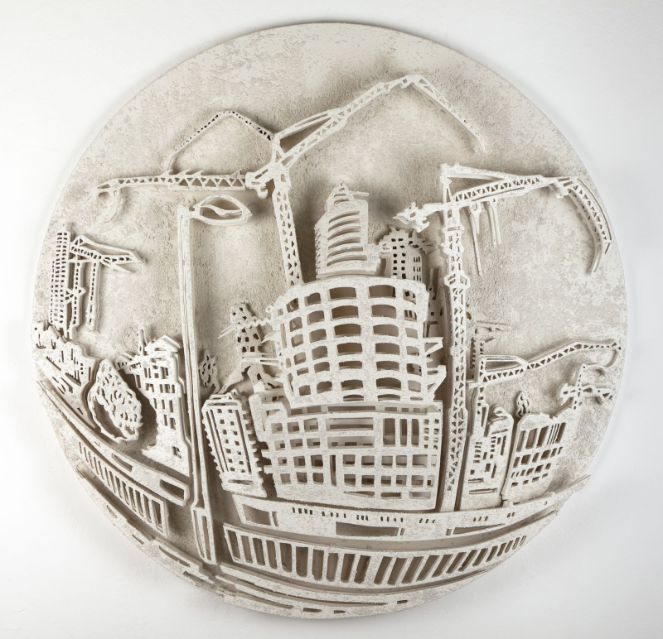
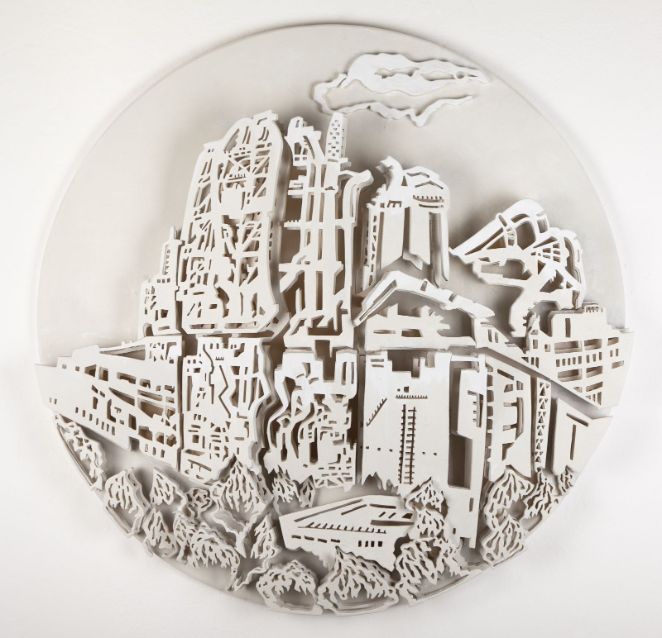
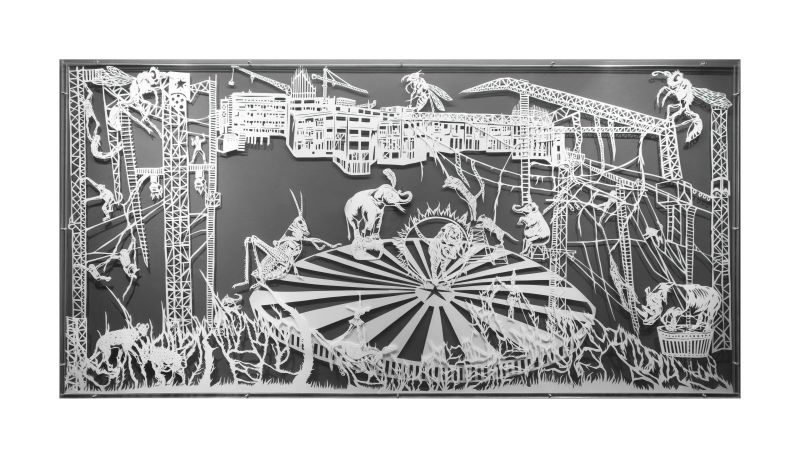
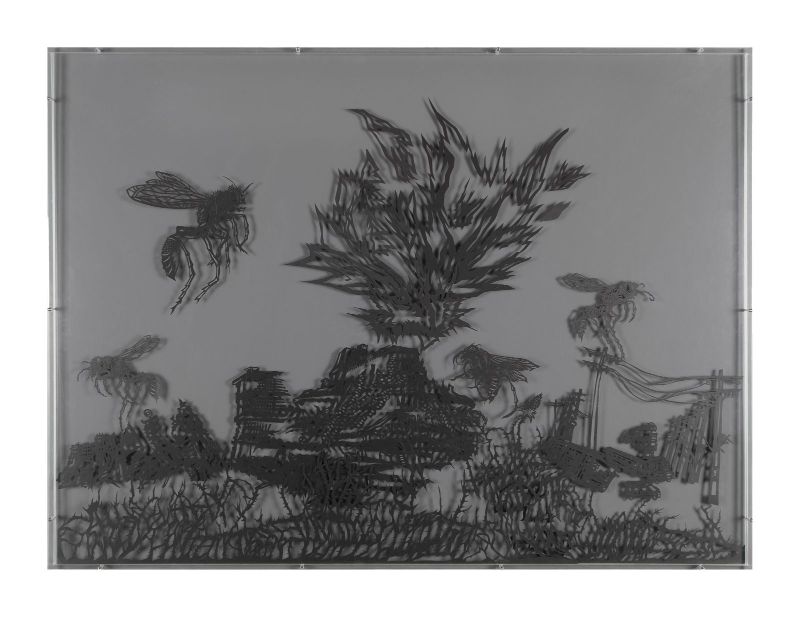
Let us look at the Güneş Çınar’s exhibition, which she named “Noxious Garden”. Everything stated above is expressed in this exhibition, but perhaps the work named “Ouroboros” which is about “what” a metropolis is and “how it should be defined” is the most significant. Here, the cranes, one of the unchanging images of metropolises stand; if there is a metropolis, there are cranes too. Again there are large construction sites, movement of goods, demolitions and reconstructions… Presenting cultural common grounds and then killing them… And unchanging machinery of these movements… The name “Ouroboros” given by Güneş Çınar is a reference to a mythological snake which devours its own tail. The snake feeding on its tail destroys itself but on the other hand it lives on by devouring its tail. Greeks were describing the cyclical continuity of the nature by that snake, in the meantime the work in the exhibition implies that the metropolis is an organism which devours and feeds on itself and keeps its existence on this cycle.
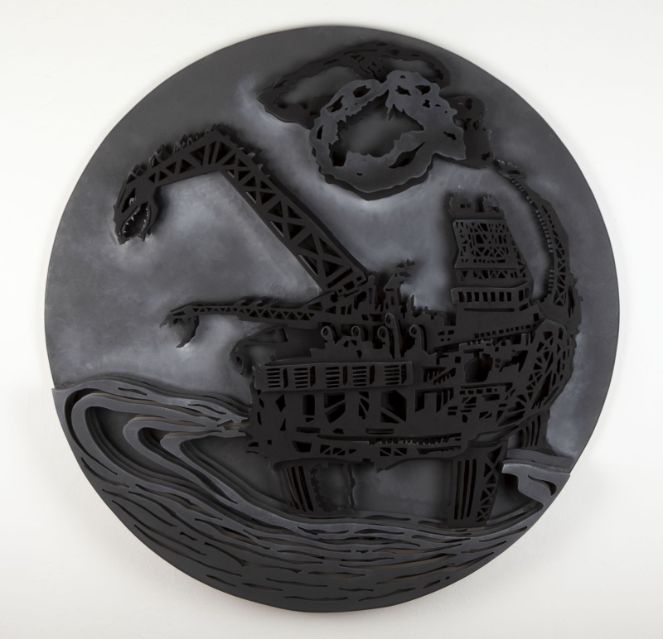
However, these subjects are of importance: While metropolises act on their own and in a self-ordained manner, they produce an aspect that matches up with neither mythology (as we have stated before), nor theories: Violence… This violence is directed upon the urbanite and threatens him in a vital manner. This is already inevitable where the rent has become a common cultural ground; it is irrelevant that whether there are urbanites in the vicinity of demolitions and their exposure to danger. The “concrete factory” Güneş Çınar has designed for this exhibition ensures to continuity of metropolis’ construction and devours everything natural (as “Ouroboros”). A “worksite” is also the same; does that worksite indicate the continuity of metropolis’ existence or its struggles in agony? Or the life of a metropolis is the integrity of these two contrasts (seeping into each other)? Of course it is: Metropolis cannot survive without killing itself every moment, thus nobody can understand that pile of rock, brick, glass and concrete indicate a newly forming structure or a “wrecked” structure from afar.
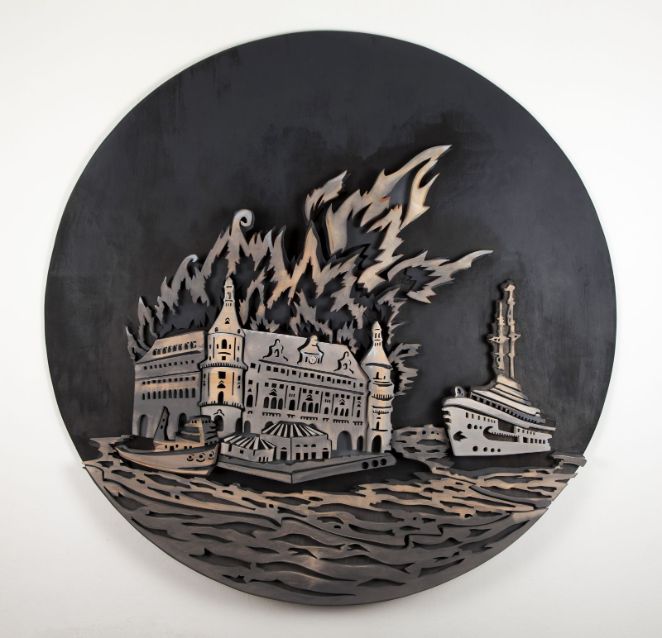
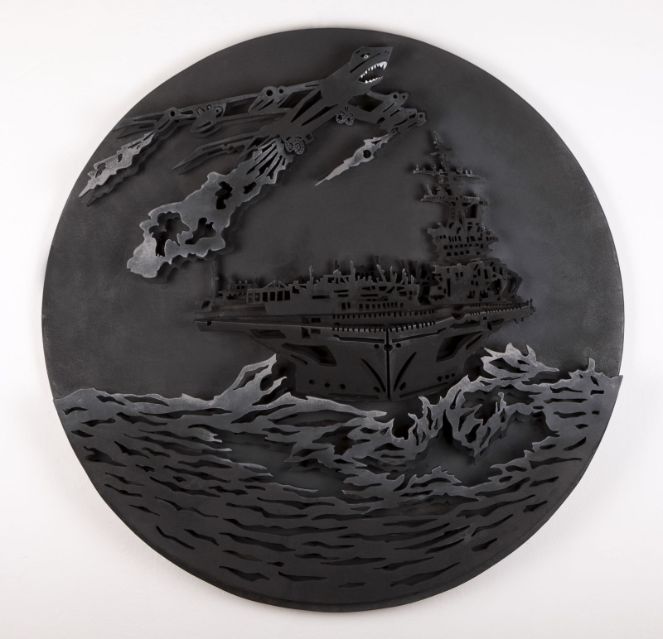
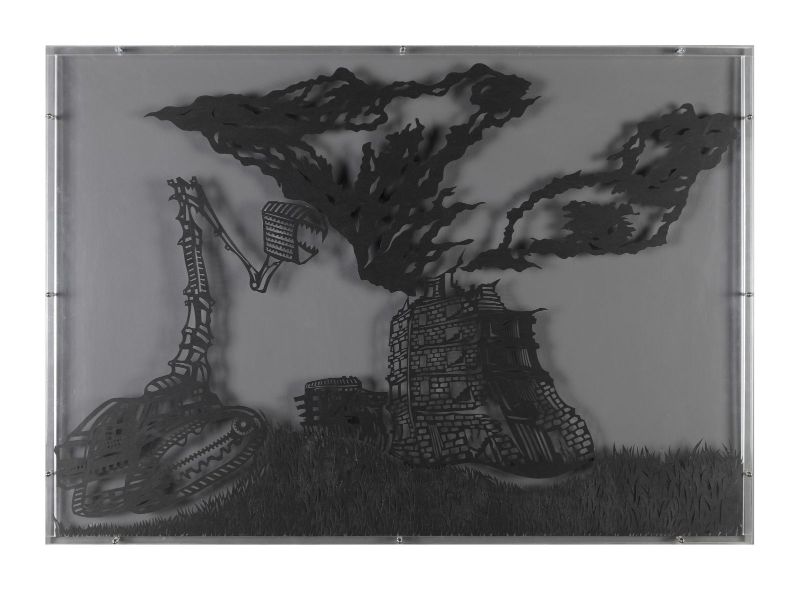
If a “metropolitan” is used to see the continued existence and struggling for life at the same time and within each other, these two data give the same impression because of familiarity, thus the destruction of cultural heritage will be perceived as continuity by the urbanite. For example, “the fire in Haydarpaşa Terminus” described by Güneş Çınar, can seem as not scary at all to an urbanite within the scope of a rent partnership. However, this is the most dreadful part of the metropolis: Fear overlapping with interest… We have to bring forward the works named “War” first and “Invasion” second, ultimately. “War” is represented as an aircraft carrier in this exhibition. The carrier we see is not surprising or dreadful for metropolises like Istanbul which have shores to open seas. The most concrete symbols of the war, these enormous heaps of metal can anchor very close to the shore and their bulks decorated with colorful banners can become a fountain of joy for “metropolitans”. They are objects of entertainment rather than a monster (for, nobody thinks about what they are going to do one day after or what they did one day before); they are nearly as innocent as toys in theme parks and “circus” tents situated in some part of the city.
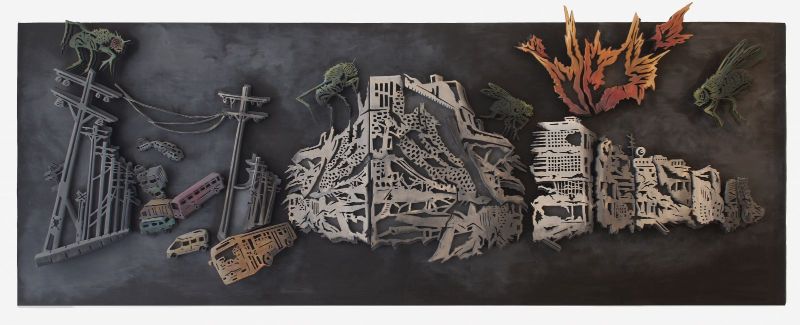
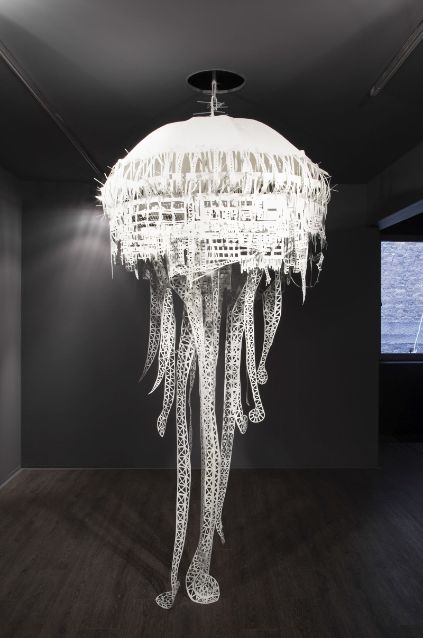
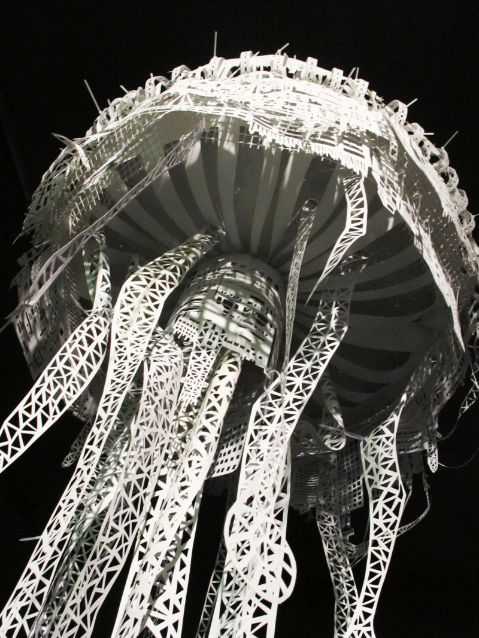
The work named “Invasion” reflects the same emotion that aircraft carrier reflects to us. Created by a complex technique, Güneş Çınar presents a gigantic jellyfish to audience in this work. That jellyfish metaphorically means something: Relating the jellyfish that distorts the visual by invading the shores completely and pollutes the common ground of the city, the sea (and thought by some people as “insufferable”) with indications of rent spread across all city… Identifying the “insufferable” presence of jellyfish with indications of rent… However, something is missing in this metaphor; giant jellyfish in the exhibition does not seem as “insufferable” much. This resembles the designs of “utopic city” of architects or city planners who is interested in the philosophy of deconstruction. So, a metropolis invaded by rent is reincarnated in the plane of utopia. Thus it happens once again; when the metropolis is ruined and seems “insufferable”, it creates a utopia from that ruin; just like the life cycle of “Ouroboros”…
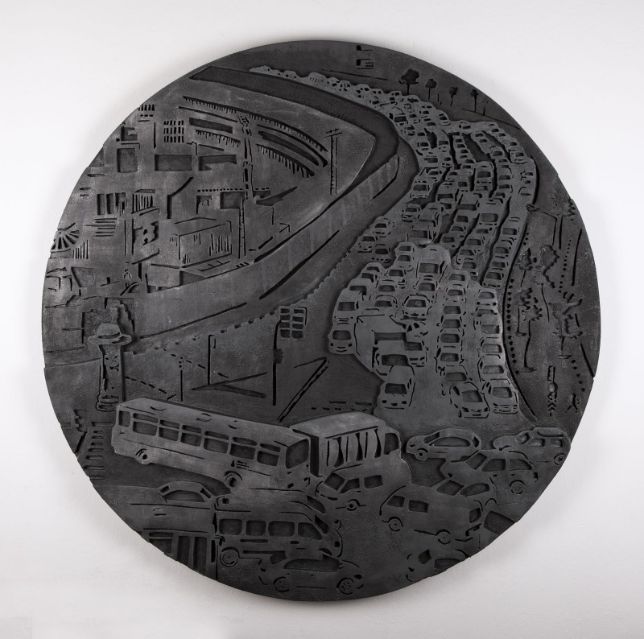
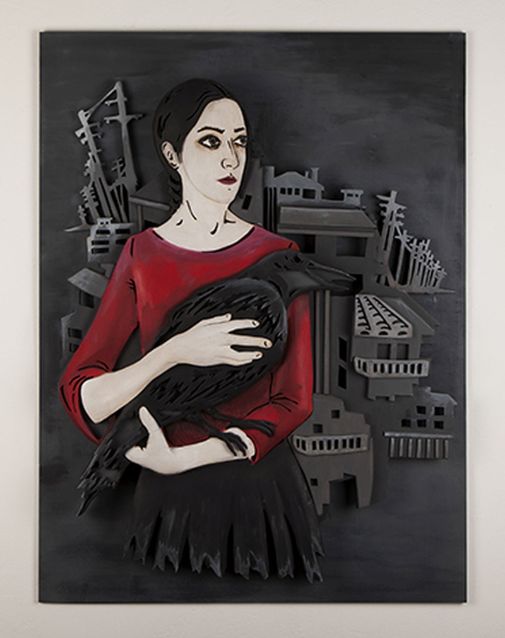
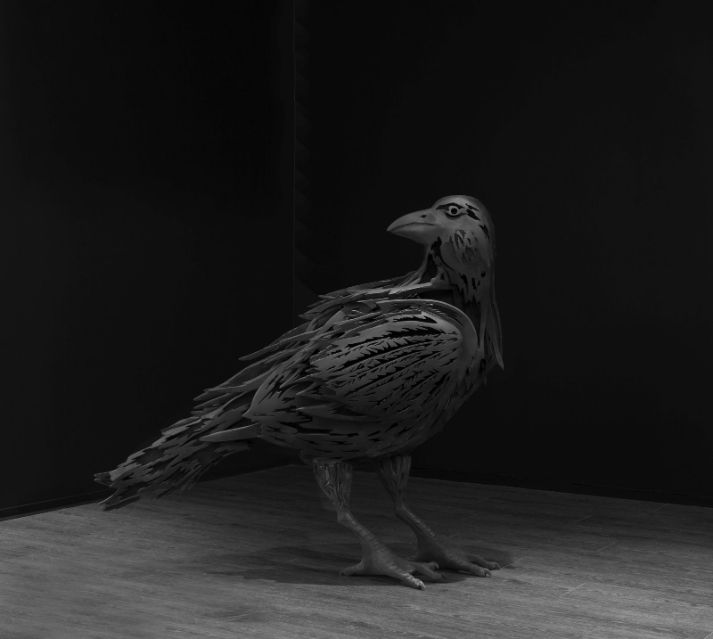
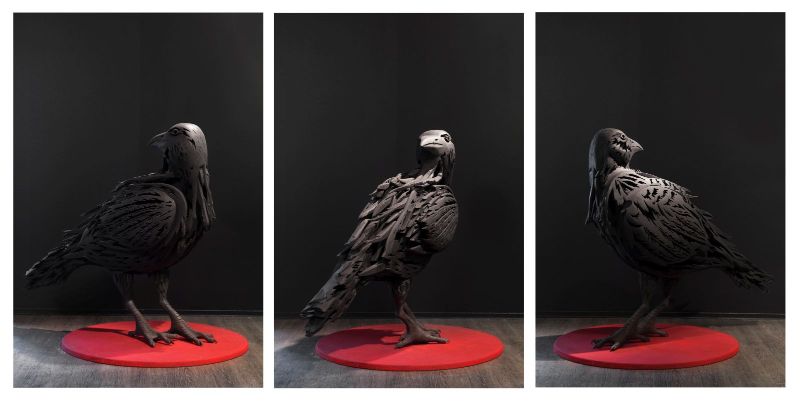
When we are exposed to countless stimulants that metropolis hurls on us, when we are in the “claustrophobic” environment of the traffic in the streets, when we confuse “insufferable” conditions with utopias, when we experience the impossibility to think of a city without rent but even being unable to fear from these after some extent, we will sense a “watcher’s” eyes upon us: A crow located in the middle of the exhibition… If we have not seen its remarkable body in the exhibition, perhaps we would not have recognized that hundreds of crows are flying all around us.